
Native modular runtime architecture for Windows.
Forsetti provides module discovery, compatibility validation, entitlement-aware activation, and structured UI extensibility — built entirely on C++20, WinUI 3, and the Windows SDK for native Windows integration.
#include <ForsettiCore/ForsettiRuntime.h>

auto runtime = std::make_unique<Forsetti::ForsettiRuntime>(
    std::move(moduleManager),
    entitlementProvider,
    eventBus,
    "./manifests"
);

runtime->boot();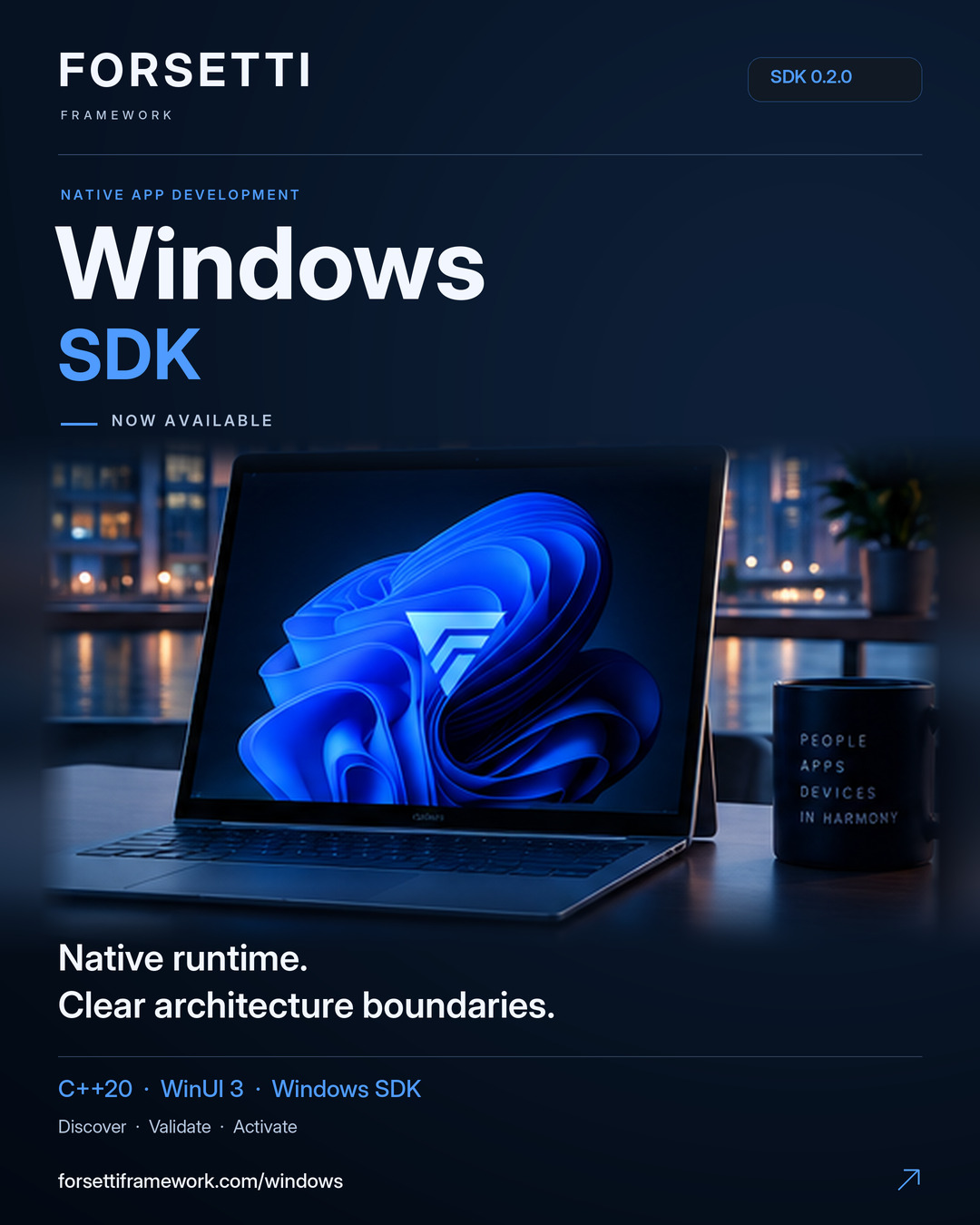
SDK 0.2.0
Forsetti Windows SDK
A native x64 distribution of the C++20 runtime, packaged for applications to consume outside the framework source tree.
- Debug and Release each include ForsettiCore, ForsettiPlatform, and ForsettiHostTemplate, with static libraries, 34 public headers, and relocatable CMake metadata.
- Install the SDK outside the application source tree, read CONSUMPTION_POLICY.md, and consume it with find_package(ForsettiFramework CONFIG REQUIRED).
- Requires Windows x64, C++20, and Visual Studio 2022. nlohmann_json 3.12.0 is installed separately.
What Forsetti Is
A sealed, contract-first modular runtime that enforces architecture boundaries at every layer. Modules declare capabilities through contracts, undergo compatibility validation before activation, and contribute UI through structured extension points — all within a native Windows runtime environment.
Contract-First
Every module declares its capabilities and requirements through explicit contracts. No implicit coupling, no hidden dependencies.
Boundary-First
Strict architecture boundaries are enforced at compile time and runtime. Modules cannot reach across boundaries without going through defined extension points.
Policy-First
Entitlement-aware activation ensures modules are only loaded when their policy requirements are met. Fine-grained control over what runs, when, and where.
Core Runtime Capabilities
Module Discovery
Automatic discovery and registration of modules at runtime. The framework scans, identifies, and catalogs available modules without manual configuration.
Compatibility Validation
Modules are validated against host requirements, platform constraints, and dependency contracts before activation. Incompatible modules are rejected cleanly.
Entitlement-Aware Unlocking
Activation is gated by entitlements. Modules declare required entitlements and the runtime enforces access policies before granting activation.
Activation Orchestration
Coordinated module activation with dependency ordering, lifecycle management, and graceful error handling. Modules activate in the correct sequence every time.
UI Contribution Model
Modules contribute WinUI 3 views through structured extension points. The host application defines contribution slots, and modules fill them according to contracts.
Native Host Integration
Deep integration with the host application through native C++20 APIs. No bridging layers, no serialization overhead — pure C++20 and WinUI 3 throughout.
Why Forsetti Exists
Most modular architectures are loose conventions bolted onto existing frameworks. Forsetti is a purpose-built runtime that enforces modularity as a first-class concern.
Without Forsetti
- Module boundaries enforced by convention only
- Compatibility issues discovered at runtime crashes
- Feature gating through ad-hoc boolean flags
- UI composition through fragile view hierarchies
- Manual dependency wiring and initialization order
- Third-party abstractions over native platform APIs
With Forsetti
- Strict architecture boundaries enforced by the runtime
- Compatibility validation before any module activates
- Entitlement-aware activation with policy enforcement
- Structured UI contribution through defined extension points
- Automatic discovery and orchestrated activation
- Native C++20 and WinUI 3 throughout — no cross-platform abstraction layers
Deployment Patterns
Single-Module App
A single module packaged with the Forsetti runtime as a standalone application. Ideal for focused tools and utilities that benefit from the runtime lifecycle.
Multi-Module Application
Multiple modules composed into a single host application. Each module is discovered, validated, and activated independently within the shared runtime.
Developer Testing
Isolated module testing with mock entitlements and simulated host environments. Develop and validate modules independently before integration.
Dashboard Deployment
A dashboard-style host that dynamically loads and presents multiple module UI contributions. Users interact with a unified surface backed by independent modules.
Built For
Windows Platform Engineers
Windows developers who build with C++20, WinUI 3, and Visual Studio — and want modular architecture without leaving the native ecosystem.
Architecture-Focused Teams
Teams that value clean boundaries, contract enforcement, and disciplined module composition over rapid prototyping with loose conventions.
Project-Led Applications
Applications that need runtime module management — feature gating, entitlement-based unlocking, and structured UI contribution from independent components.
Documentation
Comprehensive guides covering module contracts, lifecycle management, UI contribution patterns, and host integration.
Read the DocsSource on GitHub
Explore the source, review the architecture, and follow development on GitHub. Covered code and documentation are available under the Apache License 2.0.
View on GitHubBuild modular Windows applications with discipline.
Forsetti gives you the runtime foundation to compose, validate, and activate modules with confidence — on Windows.